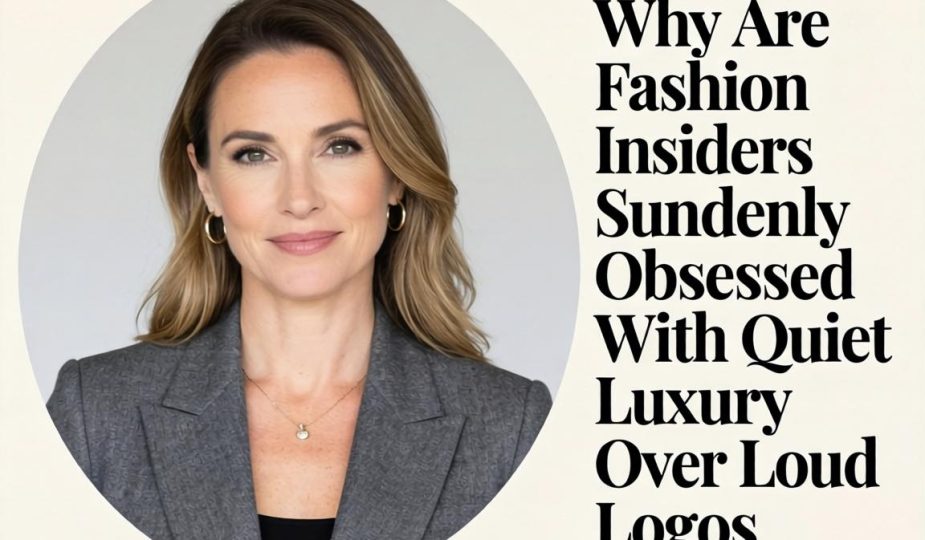
Guys, let’s be real—have you noticed how everyone’s suddenly whispering about “quiet luxury” instead of screaming brand names across their chests? I was scrolling through my feed last night (as one does at 2am), and something hit me. The most saved outfits weren’t the ones dripping in obvious monograms. They were these… subtle pieces that somehow looked more expensive without trying too hard.You might be wondering what changed. I mean, weren’t we just in the era of maximalist logomania? Here’s what I think—after years of lockdowns and economic uncertainty, people started craving pieces that felt personal rather than performative. It’s not about hiding that you spent money; it’s about signaling taste instead of just… budget.A lot of people ask me whether this shift means minimalism is back. Not exactly. Quiet luxury isn’t about owning less—it’s about owning better. Think Loro Piana cashmere
that feels like a secret hug, or The Row’s
perfectly cut trousers that make everyone ask “where are those from?” without a single visible label.What does this mean for the season? From my view, we’re seeing three non-negotiables emerge:• Fabric weight and hand-feel
—if it doesn’t feel substantial when you touch it, it won’t read expensive
• Construction details
—French seams, hand-rolled edges, invisible zippers. Most people don’t notice these, but they change everything
• Color saturation
—quiet luxury loves those muddy, complex tones. Greige, tobacco, ink blue. Colors that don’t photograph flashy but look incredible in personKeep reading, because here’s where it gets interesting. I compared two similar blazers last week—one from a loud luxury brand at $3,200, another from a heritage Italian house at $2,800. The difference? The “quiet” one had full canvas construction
and horn buttons
, while the logo-heavy version used fused interfacing and plastic. Yet the quieter piece gets more compliments. Every. Single. Time.
| Feature | Loud Luxury Approach | Quiet Luxury Approach |
|---|---|---|
| Brand visibility | Prominent logos, signature hardware | Discreet embossing, shape recognition |
| Materials | Standard with visible branding | Premium with invisible performance |
| Pricing psychology | Paying for status display | Paying for craftsmanship access |
| Longevity | Trend-driven replacement | Decade-long wardrobe building |
You might be wondering if this is just for the ultra-rich. Actually, no. The trick isn’t about spending more—it’s about spending smarter. I’ve seen Zara pieces styled to look like The Row simply because someone paid attention to fabric drape
and had the sleeves professionally shortened. Small tweaks, huge difference.Here’s what I think about accessibility though. Let’s not pretend quiet luxury isn’t still luxury. That Loro Piana sweater costs what it costs for reasons. But the mindset—chouring quality over noise, buying one perfect thing instead of three mediocre ones—that’s free. Anyone can adopt that filter.From my view, the real shift happening isn’t aesthetic. It’s philosophical. We’re moving from “look what I bought” to “look how I chose.” And honestly? That feels more modern. More confident. The woman in the perfectly fitted navy coat with no visible branding? She doesn’t need you to know the price tag. She knows.What surprised me most was checking resale values. Those quiet pieces? They hold worth better. The Row Ginza sandals
, Khaite denim
, Totême trenches
—these don’t hit discount racks because demand stays steady. Meanwhile, last season’s It-bag with giant hardware is already half-price on The RealReal.So where does this leave us? I don’t think logos are dead. They’ll cycle back, they always do. But right now, in this specific moment, there’s something powerful about dressing in a way that requires closer looking. It invites conversation rather than announcement.Most people don’t notice the difference between machine-stitched and hand-finished hems. But you will. And honestly? That’s enough. That’s the whole point.