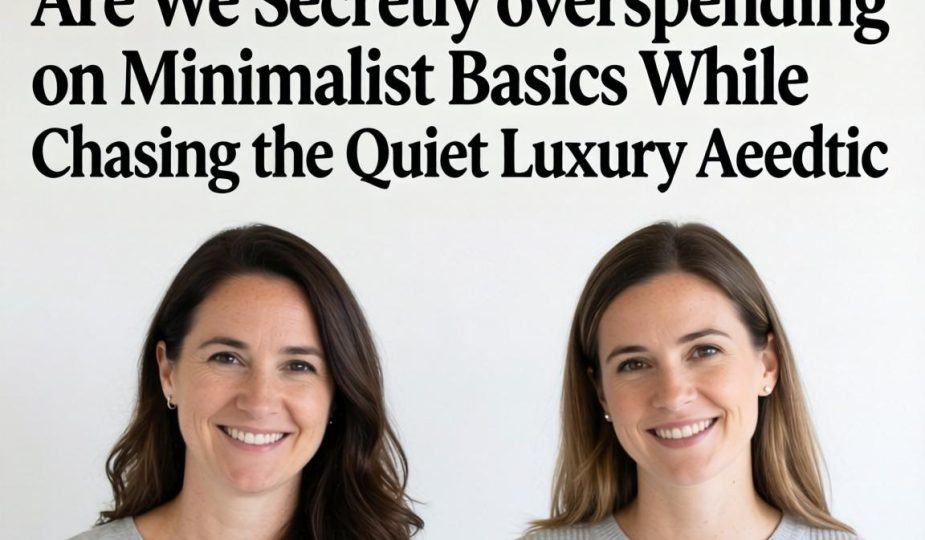
Guys, I need to talk about something that’s been bothering me every time I scroll through my saved folder on Instagram. You know those perfectly curated flat lays? The ones with the oversized camel coat
, the crisp white button-down
, the impeccable leather loafers
—no logos, no fuss, just pure expensive-looking simplicity? Here’s my question: are we actually blowing way more money on these so-called “basics” than we ever did on bold, statement-making pieces?Let’s be real. When quiet luxury first started dominating my feed—around early 2023, maybe?—I genuinely thought my wallet would thank me. No more impulse-buying neon blazers or sequined midi skirts that I wear exactly once. Just timeless, versatile pieces that “pay for themselves.” But then I started shopping. And… yeah. That theory fell apart pretty fast.Why does simple suddenly cost so much?
You might be wondering what makes a basic white tee worth $180 when you can grab one for $18 at any high street store. I wondered the same thing. So I did some digging, and here’s what I found. The quiet luxury movement isn’t really about saving money—it’s about reallocating it. Instead of buying ten trendy items, you’re supposed to buy three “perfect” ones. But those three? They hurt.The fashion industry has gotten incredibly sophisticated about this. They’ve trained us to look for 14-gauge cashmere
, single-origin cotton
, hand-finished buttonholes
. Terms that sound impressive but… do we actually know what they mean? I had to Google “gauze weight” last week. Felt a bit ridiculous, honestly.The math that doesn’t quite add up
A lot of people ask me about building a capsule wardrobe on a budget. And I always laugh a little, because the two concepts don’t really coexist. Let me show you what I mean. Here’s a rough breakdown of a “minimalist starter kit” versus what you might have spent on statement pieces five years ago:
| Essential Piece | Quiet Luxury Price | Fast Fashion Alternative | Statement Piece (2019 Vibe) |
|---|---|---|---|
| White Oxford shirt | $320–$480 | $45 | Sequin wrap dress: $150 |
| Tailored wool trousers | $580–$920 | $65 | Neon structured blazer: $95 |
| Cashmere crewneck | $420–$680 | $55 | Printed midi skirt: $85 |
| Leather shoulder bag | $1,400–$2,200 | $120 | Beaded clutch: $65 |
| Chelsea boots | $650–$1,100 | $90 | Color-blocked heels: $110 |
If you go full quiet luxury on just these five items, you’re looking at $3,370–$5,380
. Meanwhile, that entire 2019 statement wardrobe? $505
. What does this mean for the season? It means we’re spending six to ten times more to look like we’re spending less. The irony isn’t lost on me.But is the quality actually there?
Here’s where I get genuinely conflicted. Last autumn, I finally caved and bought one of those viral “perfect” white shirts. The kind every fashion editor claims changed their life. Cost me $395, which I still can’t say out loud without wincing. But I’ve worn it… maybe twice a week for eight months? It still looks new. The collar hasn’t gone weird. The buttons haven’t loosened.From my view, there’s something almost emotional about owning something that doesn’t disappoint you. Fast fashion basics always betray you eventually—the neckline stretches, the hem twists, the fabric pills in the armpits after three washes. Most people don’t notice these failures immediately, but you feel them. They erode your confidence in small, daily ways.Still, does that justify the price gap? I’m not entirely sure. I think there’s a middle ground that we don’t talk about enough. Maybe it’s buying the expensive coat but the mid-range tees. The perfect trousers but the vintage belt.The psychological trap nobody warned us about
Keep reading, because this part is something I’ve only recently figured out. Quiet luxury created this new pressure where your clothes have to whisper wealth instead of shouting it. And whispering is actually harder to fake. Anyone can save up for a logo bag. But having the “right” weight of linen, the perfect drape of wool, the subtle sheen of good silk? That requires either serious money or serious education.I’ve noticed myself studying fabric contents like I’m preparing for an exam. “Is this 100% virgin wool or just wool-blend?” “Does ‘made in Italy’ actually mean anything anymore?” It’s exhausting. Fashion used to be about expression. Now it feels like… proof of sophistication? I miss the chaos sometimes. The fun.So what should we actually do?
You might be wondering if I’m telling you to avoid quiet luxury entirely. I’m not. I genuinely love my expensive coat. It makes me feel put-together in a way that my old trendy pieces never did. But here’s what I think—we need to be honest about the cost. Stop pretending that “buying less” automatically means “spending less.” It doesn’t. It often means the opposite.My personal strategy now? I invest in the pieces that touch my skin or that I wear constantly—underwear, base layers, that one perfect blazer. Everything else? I mix high and low without shame. Vintage finds. Sale section discoveries. The occasional Zara piece that genuinely looks expensive (they exist, I promise).Because at the end of the day, the best dressed people I know aren’t following rules. They’re just… wearing what feels right. Sometimes that’s a $900 cashmere sweater. Sometimes it’s a $20 band tee from a concert in 2015. The confidence is what reads as luxury, not the price tag.That’s my take, anyway. What do you guys think—are we all just overspending to look understated? Drop your thoughts below.